Sometimes, the smallest act of kindness can change a person’s life in ways they never imagined. We often believe that we must have something valuable to give before we can help others. But true generosity does not depend on wealth. It comes from the heart, especially when giving means sacrificing something we desperately need ourselves.
This is the story of a poor boy named Daniel, who had only one piece of bread to eat. When he met a hungry stranger on a cold afternoon, he faced a difficult choice: protect the little he had or share it with someone who had even less.
His decision seemed insignificant at the time, but it would lead to a discovery that neither he nor the stranger could have predicted.
A Boy With Almost Nothing
Daniel was twelve years old and lived with his mother in a small, weathered house on the edge of a quiet town. Their home had a leaking roof, two wooden chairs, and a kitchen table that had belonged to Daniel’s father.
His father had died when Daniel was seven, leaving his mother, Margaret, to raise him alone. She worked long hours washing clothes and cleaning houses, but the money she earned was barely enough to pay the rent and buy food.
Despite their struggles, Margaret always tried to make their home feel warm. She told Daniel stories at night, mended his torn clothes, and reminded him that being poor was nothing to be ashamed of.
“Money can make life easier,” she often said, “but kindness makes life meaningful.”
Daniel believed her, although he sometimes wondered how kindness could help when their cupboard was empty.
One chilly Thursday morning, Margaret gave him a small piece of bread wrapped in a clean cloth.
“I’m sorry, sweetheart,” she said softly. “This is all we have until tomorrow. I’ll find some work today, and hopefully, we’ll have enough for dinner.”
Daniel noticed the tiredness in her eyes. She had given him the bread without keeping any for herself.
“Have you eaten, Mama?” he asked.
Margaret smiled. “Don’t worry about me. I’ll be fine.”
Daniel suspected she was pretending, but he did not argue. He kissed her cheek, tucked the bread into his pocket, and left for school.
He had no idea that before the day ended, he would face a choice that would test everything his mother had taught him.
The Stranger Beneath the Old Tree
After school, Daniel took the longer route home through a narrow lane lined with old houses and bare trees. The wind was sharp, and gray clouds covered the afternoon sky.
As he passed an abandoned stone building, he noticed an elderly man sitting beneath a large tree.
The stranger wore a faded brown coat and worn-out shoes. His silver hair was untidy, and his hands trembled as he tried to button his coat against the cold.
Daniel slowed down.
“Sir, are you all right?” he asked.
The man looked up. His eyes were tired, but there was gentleness in them.
“I’m afraid I’m not feeling very well, young man,” he replied. “I haven’t eaten since yesterday morning.”
Daniel immediately thought of the bread in his pocket.
He pulled it out and looked at it.
It was not much. Just one small piece, hard around the edges. But it was all he had.
His stomach growled. He had spent the afternoon imagining how good it would taste when he finally reached home.
For a moment, he considered walking away. He could not remember the last time he had eaten a proper meal, and his mother was probably hungry, too.
Then he looked at the stranger’s trembling hands.
Daniel remembered something his father had once told him: “You may not be able to solve everyone’s problems, son, but you can always choose not to ignore someone’s suffering.”
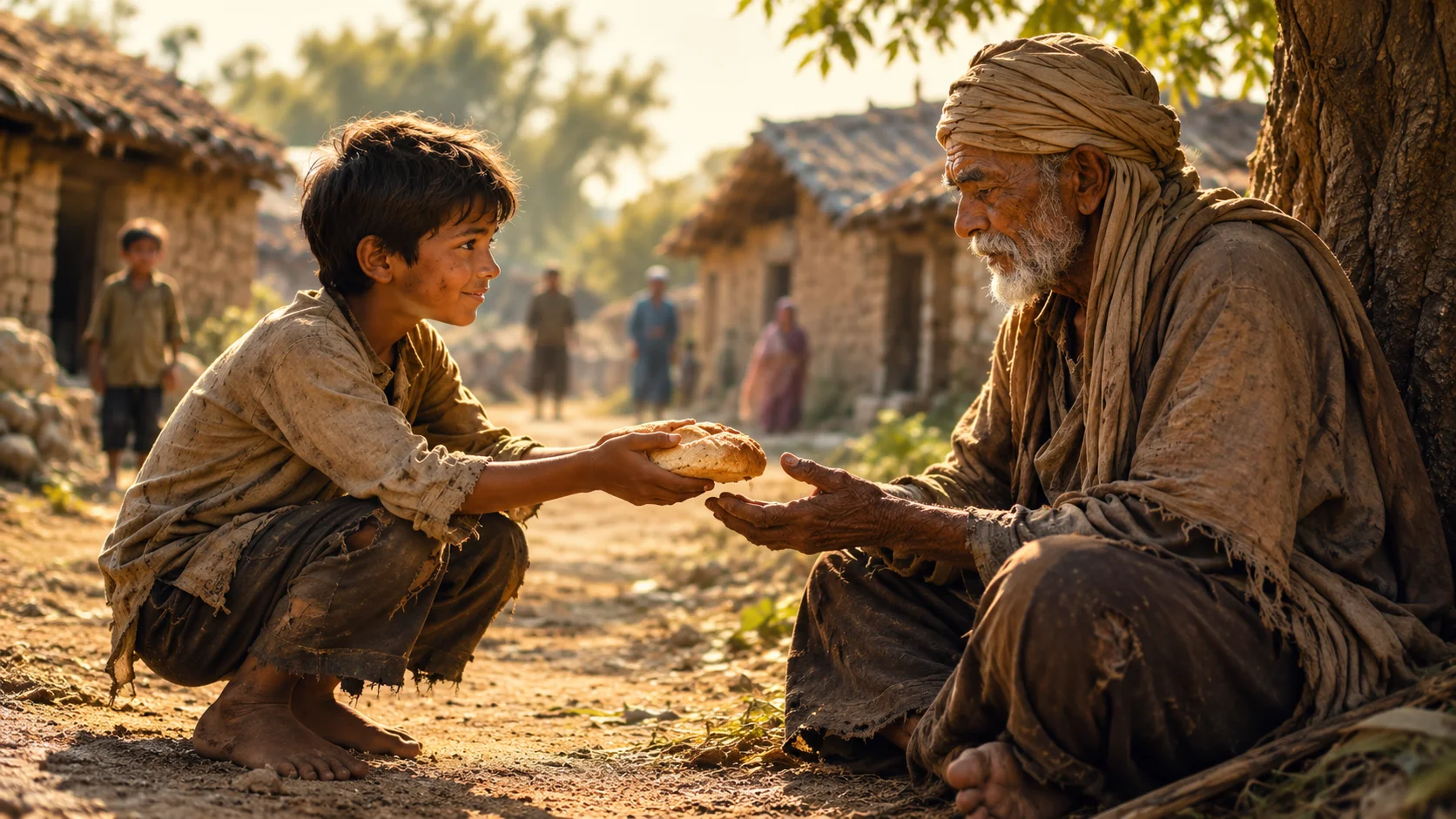
He broke the bread into two pieces.
One was slightly larger than the other. Daniel hesitated, then gave the larger piece to the stranger.
“Here, sir. It’s not much, but you should eat something.”
The old man stared at the bread as though Daniel had offered him something precious.
“What about you?” he asked.
“I’ve already had lunch,” Daniel answered.
It was a lie, but he did not want the stranger to feel guilty.
The man accepted the bread with shaking fingers and ate slowly, savoring every bite.
“What’s your name, son?” he asked when he had finished.
“Daniel.”
“Daniel,” the stranger repeated. “Why would you give your food to someone you don’t even know?”
Daniel shrugged.
“Because you’re hungry. And I know what it feels like to be hungry.”
The old man’s expression changed. For a moment, he looked as though he wanted to say something important, but the words would not come.
Instead, he asked Daniel where he lived.
Daniel pointed toward the small houses at the end of the lane.
“With my mother. She works very hard, but we don’t have much money.”
The stranger nodded thoughtfully.
“Never lose that kindness, Daniel. The world needs people who remember others when life becomes difficult.”
Daniel smiled shyly and continued home, unaware that the old man was watching him with tears in his eyes.
A Knock After Sunset
That evening, Daniel returned home to find his mother sitting at the kitchen table. She looked exhausted.
“Did you eat your bread?” she asked.
Daniel lowered his eyes.
“I gave it to someone who was hungry.”
Margaret was silent for a moment.
“You gave away your only food?”
“He hadn’t eaten since yesterday, Mama. I couldn’t just leave him there.”
Margaret looked at her son. She wanted to explain that their own situation was desperate, that kindness could not fill an empty stomach, and that he needed to take care of himself, too.
But when she saw the sincerity on his face, her words disappeared.
Instead, she pulled him into a hug.
“Your father would have been proud of you,” she whispered.
They sat together at the table, sharing a cup of warm water because there was nothing else in the house.
Daniel tried to hide his hunger. Margaret tried to hide her worry.
Neither wanted the other to suffer.
Just as they were preparing to sleep, someone knocked on the front door.
Margaret exchanged a puzzled glance with Daniel.
Nobody visited them at that hour.
She opened the door and found two strangers standing outside. One was a well-dressed woman carrying a basket filled with groceries. The other was a young man holding a large envelope.
“Good evening,” the woman said. “We’re looking for a boy named Daniel.”
Daniel stepped forward nervously.
“I’m Daniel.”
The woman smiled.
“My name is Helen. We have come on behalf of someone who would like to thank you for your kindness.”
She handed Margaret the basket. Inside were bread, rice, vegetables, eggs, milk, and enough food to last several days.
Margaret stared at the groceries in disbelief.
“But why?” she asked. “We haven’t done anything.”
Helen looked at Daniel.
“Your son did something remarkable today. He shared his food with a man who had nothing to eat.”
Daniel’s heart began to beat faster.
“The old man beneath the tree?” he asked.
Helen nodded.
“Yes. His name is Edward Bennett.”
Margaret recognized the name immediately. Edward Bennett was a wealthy businessman who had once owned several factories in the town. Years earlier, he had sold his company and disappeared from public life.
“What does he want with us?” Margaret asked cautiously.
Helen’s expression grew serious.
“Mr. Bennett would like to meet Daniel tomorrow. There is something he needs to explain.”
Before leaving, the young man handed Margaret the envelope.
Inside was a handwritten note.
To the boy who gave away his last piece of bread: Tomorrow, please come to the old town library at ten o’clock. There is a story you deserve to hear.
Daniel read the note twice.
Who was Edward Bennett? Why had he been sitting alone beneath a tree? And how had such a small act of kindness brought these strangers to their door?
For the first time in many months, Daniel went to sleep thinking about something other than hunger.
The Secret of the Old Man
The following morning, Margaret accompanied Daniel to the town library.
Edward Bennett was waiting beside a tall window. In the daylight, he looked different from the exhausted stranger Daniel had met the previous afternoon. His coat was clean, and his posture was straighter, but his eyes still carried a deep sadness.
“Daniel,” he said warmly. “I’m glad you came.”
He invited them to sit and placed an old photograph on the table.
It showed a younger Edward standing beside a smiling woman and a little boy.
“This was my family,” he explained. “My wife, Anna, and our son, Michael.”
Edward’s voice trembled slightly.
“Many years ago, I believed that success meant earning more money than anyone else. I worked constantly. I missed birthdays, school performances, and ordinary evenings at home. I told myself that I was doing everything for my family.”
He paused and looked down at the photograph.
“Then my wife became seriously ill. I spent money on the best treatment I could find, but I could not buy more time with her. After she died, my son and I grew distant. He believed I had chosen my business over our family.”
Edward explained that his son had eventually left town after an argument. They exchanged occasional letters, but their relationship remained strained.
Then, several years later, Edward received a letter telling him that Michael had died unexpectedly.
“I had more money than I could ever spend,” Edward said quietly, “but I could not go back and give my son one more afternoon. I could not apologize in person. I could not change the past.”
He looked at Daniel.
“After that, I began visiting the places where I had spent my childhood. Yesterday, I was walking through that lane when I realized I had forgotten to eat. I was tired, ashamed of my loneliness, and wondering whether kindness still existed in a world where everyone seemed to be rushing somewhere.”
His eyes filled with tears.
“Then you came along. You gave me food even though you had almost nothing yourself.”
Daniel listened without speaking.
Edward continued.
“I discovered something about myself yesterday. I had spent years measuring people’s worth by their achievements, their clothes, and their possessions. You reminded me that the most important things cannot be measured that way.”
He reached into his bag and took out another envelope.
“I would like to help you and your mother. I have arranged to pay your school expenses and provide your family with financial assistance while your mother finds more stable work.”
Margaret immediately shook her head.
“Mr. Bennett, we appreciate what you’ve done, but we cannot accept charity simply because my son shared his lunch.”
Edward smiled gently.
“This is not a payment for a piece of bread. Nothing could make that moment a transaction. It is an opportunity I can offer, and I hope you will allow me to do so.”
He turned to Daniel.
“I cannot change the years I lost with my son. But perhaps I can help another young person build a future filled with opportunities I never appreciated when I was young.”
Margaret looked at her son, then at the man sitting before them.
After a long silence, she accepted the envelope.
“Thank you,” she whispered. “We will never forget this.”
Daniel looked at Edward and asked a question nobody else had thought to ask.
“Sir, will you be all right now?”
Edward blinked in surprise.
“What do you mean?”
“You seemed very lonely yesterday. You have helped us, but who helps you?”
For several seconds, Edward said nothing.
Then he laughed softly, though tears rolled down his cheeks.
“Perhaps,” he said, “that is exactly the question I needed someone to ask.”
A Friendship Worth More Than Gold
Over the following months, Daniel’s life slowly began to change.
He received new school supplies, his mother found steady employment at a local community center, and their home was repaired with help from a neighborhood charity supported by Edward.
For the first time in years, Margaret could buy groceries without calculating every coin. Daniel could concentrate on his studies instead of wondering whether his family would have dinner.
But the greatest change was not financial.
Edward began visiting them every Sunday.
At first, he brought books for Daniel and groceries for Margaret. Eventually, he started coming empty-handed, staying simply to talk.
Daniel listened to his stories about the town as it had been decades earlier. Edward helped him with mathematics and encouraged him to pursue his dream of becoming a teacher.
Margaret prepared tea, and the three of them often sat together around the old kitchen table.
Their friendship grew naturally, without promises or expectations.
One Sunday afternoon, Edward brought the photograph of his family again.
Daniel studied the picture carefully.
“Your son looks kind,” he said.
“He was,” Edward replied. “Much kinder than I understood at the time.”
“Do you think he would have forgiven you?”
Edward considered the question.
“I don’t know. I hope he will. But I’ve learned that forgiveness is not something we can demand. We can only become better people and treat the people still beside us with more love.”
Daniel nodded thoughtfully.
“Then you should keep visiting us. You’re teaching me a lot, too.”
Edward smiled.
For the first time in many years, his Sundays no longer felt empty.
The Bread That Changed Three Lives
Years passed.
Daniel grew into a thoughtful young man and eventually became a teacher. He never forgot the hunger he had experienced as a child, nor the stranger who had helped his family when they needed it most.
When he received his first salary, he used part of it to help establish a small food pantry at his school. Students who arrived without breakfast could quietly take a sandwich, a piece of fruit, or a carton of milk without being questioned or embarrassed.
He called it The Open Table.
A simple sign hung above the pantry:
No one should have to learn on an empty stomach.
Edward attended the opening ceremony. He was older now, his silver hair almost completely white, but his smile was as warm as Daniel remembered.
Standing beside the pantry, Edward watched children collect their food and turn toward their classrooms.
“This is wonderful,” he told Daniel.
Daniel shook his head.
“It started with a piece of bread.”
Edward placed a hand on his shoulder.
“No, son. It started with a choice.”
That evening, they walked together through the same lane where they had first met. The old tree still stood beside the stone building, its branches stretching toward the sky.
Daniel stopped beneath it.
“Do you remember that day?” he asked.
Edward laughed softly.
“Every single moment.”
“I thought I was giving you half of my bread,” Daniel said. “I never imagined what would happen afterward.”
Edward looked at him with affection.
“And I thought I was simply a lonely man having a difficult day. I never imagined that a hungry boy would teach me more about life than all my years of business.”
They stood quietly as the evening sunlight filtered through the branches.
Neither man could change the past. Edward could not recover the years he had lost with his family, and Daniel could not erase the hardships of his childhood.
But they had discovered something better than the power to rewrite yesterday.
They had learned to make tomorrow more meaningful.
Daniel had shared his last piece of bread because someone was hungry. Edward had responded with generosity because a child reminded him of the person he wanted to become.
And together, they had helped create a place where kindness could continue long after their first meeting.
Conclusion: Never Underestimate a Small Act of Kindness
Daniel’s story reminds us that generosity does not depend on how much we possess. Sometimes, the person with the least to give understands the value of giving better than anyone else.
A shared meal, a listening ear, a sincere question, or a few minutes spent helping a stranger may seem insignificant. Yet these small gestures can offer comfort when someone feels forgotten, hope when life seems impossible, and encouragement when a person has nearly given up.
Kindness does not guarantee that we will receive a reward. We should never help others simply because we expect something in return. Its true value lies in recognizing another person’s suffering and choosing to respond with compassion.
Daniel gave away his last piece of bread without knowing who Edward was or what the future might hold. He did it because someone needed help.
That was what made his action extraordinary.
The greatest gift you can offer another person is not always something you can buy. Sometimes, it is a small part of what you have, given at the moment someone needs it most.
And sometimes, that small gift becomes the beginning of a story neither person will ever forget.