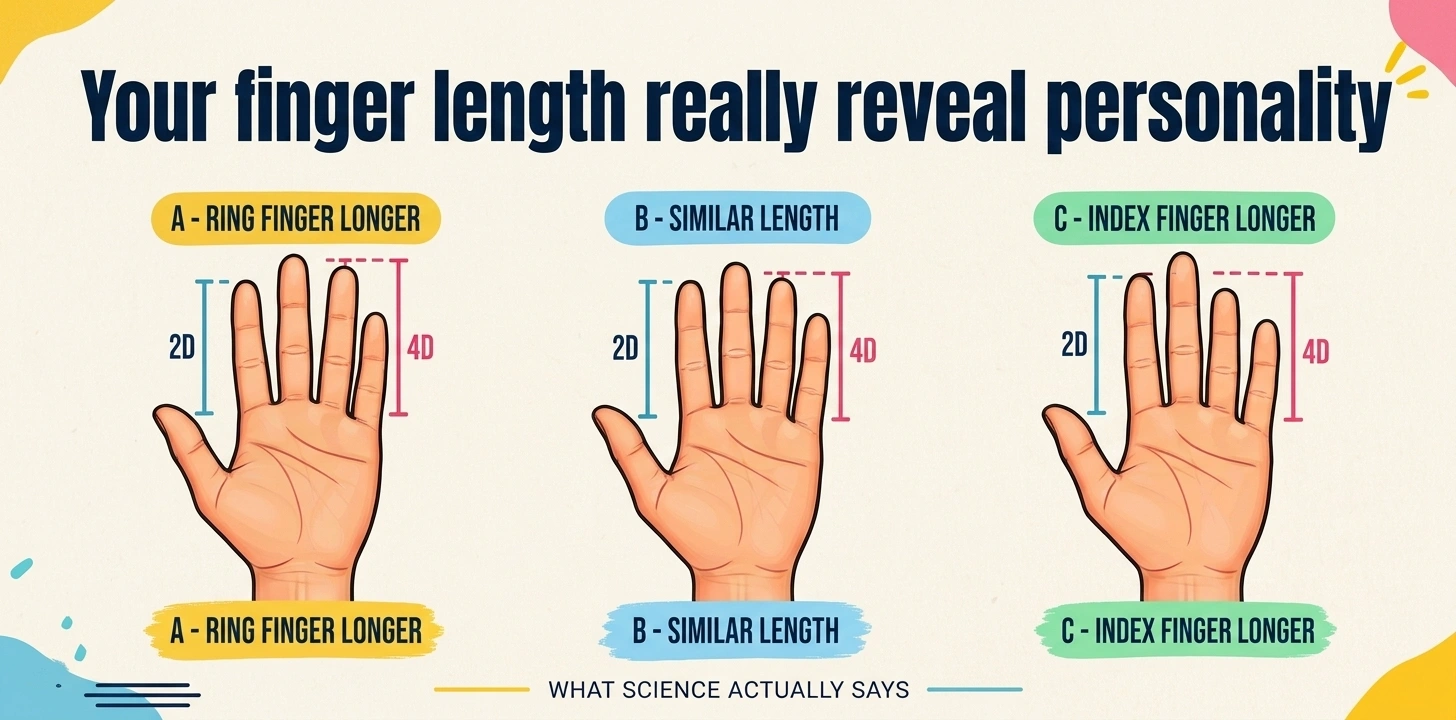
Look at your hands and compare your index finger to your ring finger. Is one noticeably longer than the other?
This simple comparison has become the basis for hundreds of online personality tests. Depending on the chart you get, your fingers can supposedly reveal whether you’re confident, sensitive, competitive, calm, or naturally good with people.
It makes for an entertaining test, but there’s more to the story than just a viral graphic.
Scientists have studied finger proportions for years, specifically the 2D:4D ratio, the relationship between the length of your index finger and ring finger. The research is real, but the results often go far beyond what the evidence can tell us.
Finger Length Personality Test: What Do the Popular Claims Say?
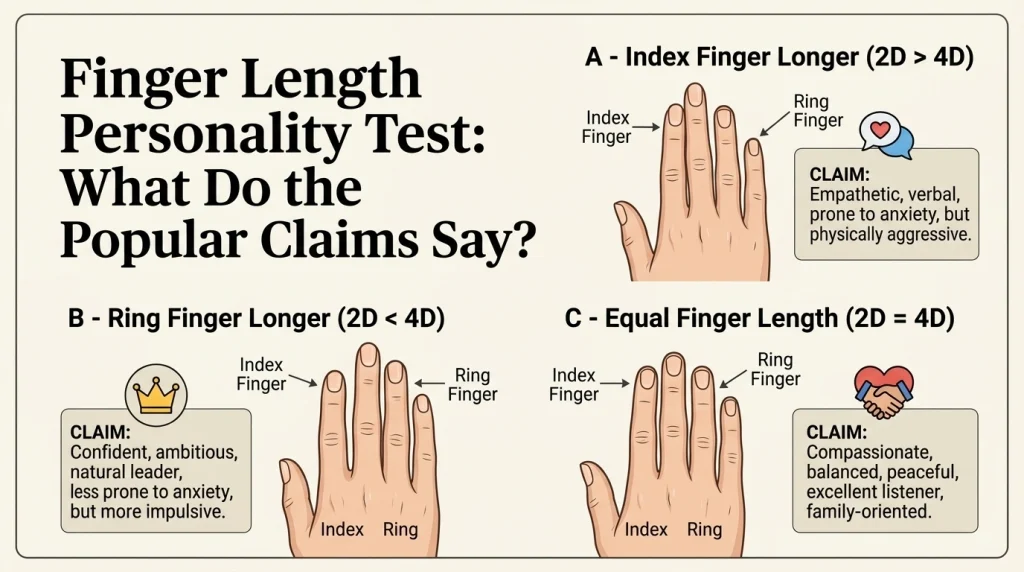
Most online tests work by placing your fingers into a few simple categories. The most common comparison is between the index and ring fingers.
Here’s a quick look at the claims you’ll usually see:
| Finger pattern | Common online claim | What the research tells us |
| Ring finger longer | Confident, competitive, bold, risk-taking | Some research has explored links with behavior, but effects are generally small and inconsistent |
| Index finger longer | Calm, sensitive, empathetic, artistic | These personality descriptions aren’t scientifically established |
| Similar index and ring fingers | Balanced, peaceful, emotionally steady | No strong evidence connects this pattern with a specific personality type |
| Long or short pinky | Better communication or stronger social skills | The scientific literature doesn’t establish pinky length as a personality test |
The table is useful for one reason: it shows how much more specific internet claims tend to be than the actual research.
A finger pattern can be interesting. It doesn’t come with a ready-made personality label.
The Science Behind the 2D:4D Ratio
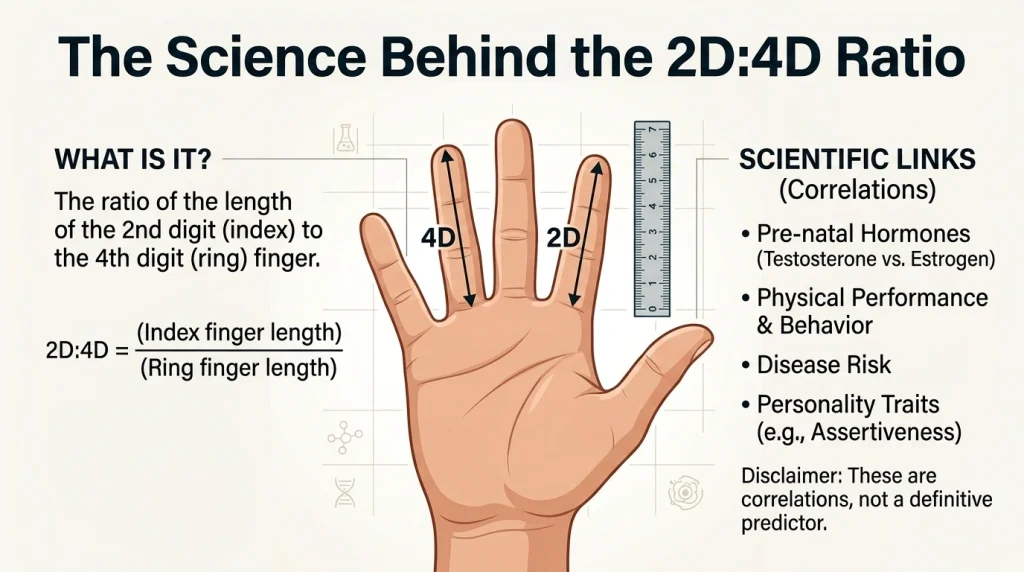
The 2D:4D ratio is simply a measurement that compares your second digit (index finger) to your fourth digit (ring finger).
If your ring finger is longer than your index finger, you have a low ratio. If your index finger is longer, you have a high ratio.
Researchers became interested in this measurement because finger development occurs before birth, and scientists have investigated whether digit ratios can reflect aspects of early biological development.
This is where things often get oversimplified online.
You may see claims that a low 2D:4D automatically means high prenatal testosterone, while a high ratio means high prenatal estrogen. The relationship is much more complex than that. Researchers have suggested links between digit ratios and prenatal hormone exposure, but the 2D:4D is not a direct hormone test.
Scientists have also looked at possible links between digit ratios and behavior, including personality traits. Some studies have reported associations, but the results are not consistent enough to turn the measurement into a reliable personality test.
Can finger length indicate intelligence?
You may also come across claims that finger length and intelligence are linked, specifically through the 2D:4D ratio.
Some studies have investigated whether digit ratios are associated with verbal or numerical intelligence. For example, one study reported relationships between right-handed 2D:4D and measures of verbal and numerical intelligence in a relatively small sample.
This does not mean that you can tell how intelligent someone is by looking at their fingers.
Intelligence is a complex set of abilities, and a single physical measurement cannot provide a reliable intelligence score. Research on finger proportions and cognitive ability has produced limited results, so finger length should not be used as a test of intelligence.
In practice, a long ring finger does not mean that a person is naturally good at math, while a long index finger does not mean that a person is more verbally intelligent.
Finger length personality traits: Where the myths come from.
Look up finger length personality traits and you will quickly find the same traits that appear over and over again:
- Confidence
- Aggression
- Creativity
- Sociability
- Emotional sensitivity
- Risk-taking
- Independence
The problem is not that these traits are impossible to study. The assumption is that finger length can tell you what traits a particular person has.
Personality can be better understood by looking at real-world behavior, including social media behavior.
Personality research typically relies on accurate questionnaires and behavioral measures rather than physical appearance. A person’s confidence, for example, can vary depending on their environment and experiences. The same applies to communication styles, emotional responses, and social behavior.
This is why a broad explanation from a finger test can sometimes feel accurate without actually being a reliable measurement.
What about finger lengths in women and men?
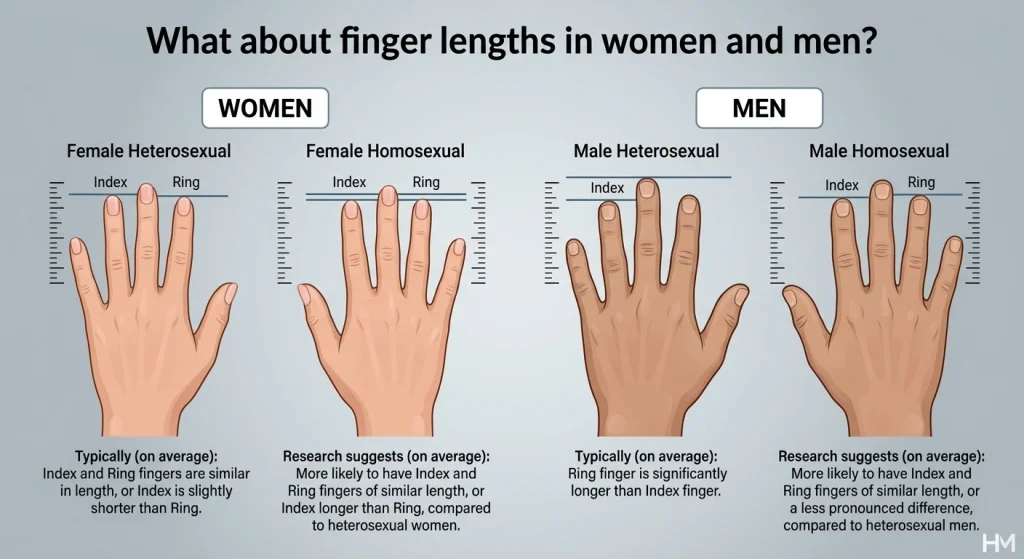
Finding a female with a longer finger personality and a male with a longer finger personality often makes the subject more accurate than it is.
There is a real average difference in the 2D:4D measurement between men and women, which is one reason researchers have examined the ratio in biological and developmental studies. On average, men have a lower 2D:4D ratio than women.
But averages don’t define every individual.
Two people of the same sex can have very different finger ratios. And having a specific ratio doesn’t tell you whether someone is ambitious, emotional, outgoing, competitive, or shy.
This is an important distinction that gets lost in many online charts: differences between groups don’t automatically make useful predictions about an individual.
What does a longer ring finger mean in men and women?
If your ring finger is longer than your index finger, it simply means that you have a relatively low 2D:4D ratio.
This pattern is more common in men on average than in women, but it is also found in many women.
Online personality tests can associate a long ring finger with confidence, competitiveness, athletic ability, or risk-taking. Some studies have investigated possible links between a low 2D:4D ratio and behavioral traits, but the relationships are not strong enough to predict an individual’s personality.
So whether you are a man or a woman, a long ring finger does not come with a fixed personality meaning.
Can your fingers tell you anything about your health?
This is another area where online content can go a long way.
Research has examined potential associations between 2D:4D and various health and behavioral outcomes. But an association observed in a research population is not the same thing as a diagnostic test.
The length of your finger can’t tell you if you have or will develop a certain medical condition.
The same principle applies to personality. Even when researchers find a statistical relationship, that doesn’t mean the measurement is accurate enough to predict a person.
So if a website suggests that measuring your fingers can take the place of a medical examination, the claim is worth ignoring.
Why Finger Length Personality Tests Can Feel So Accurate
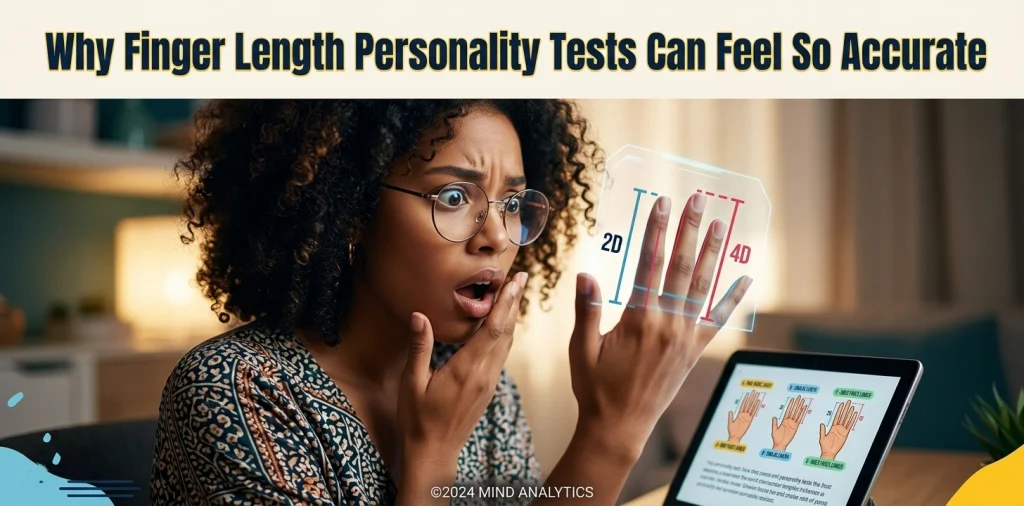
There’s a simple reason why these tests can be surprisingly convincing.
Many personality descriptions are extensive. Almost anyone can recognize themselves in statements such as “You care about people but sometimes need time alone” or “You are confident in some situations but cautious in others.”
This is one reason why personality quizzes can feel personal even when the underlying method isn’t particularly accurate.
The finger length test adds another layer: you can physically check the result yourself. This makes the experience feel more objective than a random quiz, even though the measurements themselves don’t provide a complete picture of your personality.
So, can finger length reveal your personality?
Not likely.
The 2D:4D ratio is a legitimate subject of scientific research, and researchers continue to explore what finger ratios can tell us about development and human biology.
But that’s a very different thing from saying that your fingers can reveal your personality.
Some studies have reported relationships between digit ratios and specific traits, while other research has found weak, inconsistent, or difficult to replicate results. For example, one large study that examined more than 2,000 participants found that the relationship between finger length measures and personality was generally weak and inconsistent.
Your hands can definitely tell you something about your biology. They just can’t tell the whole story.
So if you want to compare your fingers to the viral finger length personality test, go ahead. It could be a fun conversation starter.